
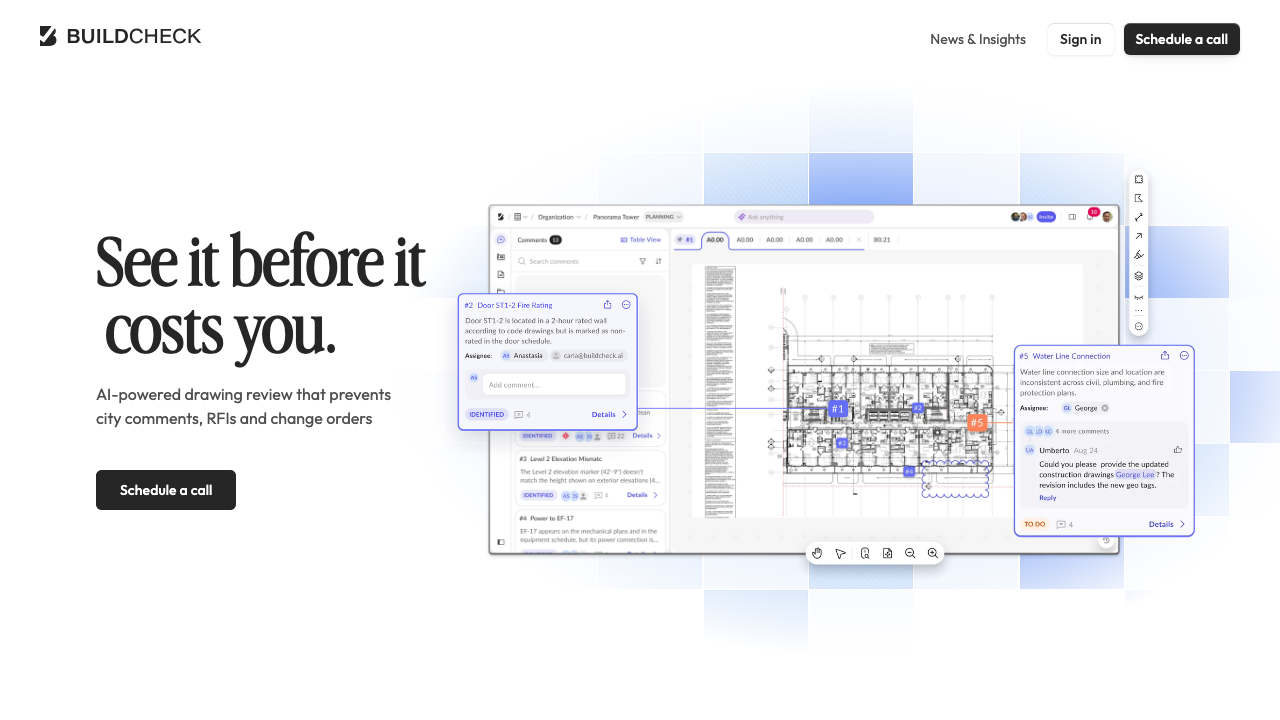
See it before it costs you.
BUILDCHECK is an innovative venture-backed startup emerging from Stanford University, dedicated to enhancing construction workflows through artificial intelligence. The primary purpose of BUILDCHECK is to serve as a 'spell-checker' for construction designs, enabling real estate developers, general contractors, and architects to identify potential issues in their plans before they escalate into costly change orders, requests for information (RFIs), or municipal comments. This proactive approach helps streamline the construction process and mitigate risks associated with design errors. The core features of BUILDCHECK include its advanced AI-driven analysis that scans construction plans for discrepancies, a user-friendly interface that allows for easy navigation and understanding of detected issues, and integration capabilities that facilitate seamless collaboration among project stakeholders. Unique to BUILDCHECK is its focus on preventing errors before they occur, which sets it apart from traditional construction management tools that often address problems post-factum. The platform is designed to be intuitive, making it accessible for professionals across various roles in the construction industry. BUILDCHECK significantly improves workflows by allowing teams to catch design flaws early in the project lifecycle, thereby saving time and reducing costs associated with rework and delays. The tool is particularly beneficial for large-scale projects where multiple stakeholders are involved, as it fosters better communication and alignment among architects, contractors, and developers. Companies that adopt BUILDCHECK can expect measurable benefits, including reduced project timelines and enhanced overall efficiency in project execution. The platform is cloud-based, ensuring that users can access it from anywhere, which is crucial for teams working on-site and remotely. Its integration capabilities allow it to work alongside existing construction management software, making implementation straightforward and minimizing disruption to current workflows. With a focus on user experience and practical application, BUILDCHECK is positioned to become a vital tool in the construction technology landscape, helping industry leaders to see errors before they incur costs.
AI Solutions for the Toughest Projects —from Facilities to Complex Urban Developments
Digital Blue Foam is an innovative AI-powered building design and planning software that leverages generative design and spatial analytics to enhance project delivery in the construction industry. Its primary purpose is to streamline the early-stage feasibility studies and sustainable design processes, addressing the challenges faced by architects, planners, and developers in creating future-proof buildings and cities. By providing a user-friendly interface, Digital Blue Foam empowers professionals in the architecture and planning sectors to make informed decisions that balance growth with sustainability. The platform boasts several core features that set it apart in the market. Key capabilities include a generative design engine that adapts land use and network plans in seconds, enabling users to simulate outcomes for diverse demographics. Additionally, it integrates real-time transport data and predictive simulations to analyze CO₂ emissions at the neighborhood scale, facilitating the design of low-carbon neighborhoods. The unified spatial data platform allows for seamless collaboration and quick zoning analysis, significantly reducing project approval times. Digital Blue Foam improves various construction workflows, particularly in urban planning and master planning. By utilizing its smart simulations and evidence-based strategies, users can effectively tackle challenges such as regulatory constraints, budget limitations, and the integration of community needs. The measurable benefits include time savings in project approvals, enhanced design accuracy, and a more equitable approach to urban development, making it particularly beneficial for large-scale urban projects and organizations focused on sustainable development. The platform is cloud-based, allowing for easy access and collaboration among teams regardless of location. Its integration capabilities with existing design software and tools further enhance its usability, making it a versatile solution for modern construction challenges. Digital Blue Foam's commitment to innovation is evident in its ongoing development of new features, such as the DBF HIKARI interface, which combines zoning documentation and compliance rules into a single platform for real-time urban decision-making. With a growing presence in the architecture and planning industry, Digital Blue Foam has garnered attention for its unique approach to integrating AI in urban design. The company has established partnerships with notable organizations and continues to participate in industry conferences, showcasing its commitment to advancing the future of urban planning and sustainable design.
| Attribute | BUILDCHECK | DBF |
|---|---|---|
| Category | BIM & Design | BIM & Design |
| Parent Company | — | — |
| Tagline | See it before it costs you. | AI Solutions for the Toughest Projects —from Facilities to Complex Urban Developments |
| Sub-categories | AI | AI |





Our directory has 8+ tools in this category. Browse them all or submit your own.

